
Early detection of Alzheimer’s disease
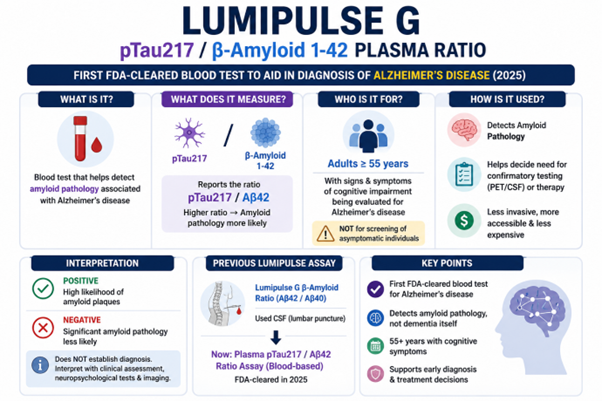
Lumipulse G is an FDA-cleared biomarker assay used to aid in the diagnosis of Alzheimer’s disease. The newest version is the Lumipulse G pTau217/β-Amyloid 1-42 Plasma Ratio, which is the first FDA-cleared blood test to help detect amyloid pathology associated with Alzheimer’s disease.
What does it measure?
It measures the ratio of:
- Phosphorylated tau-217 (pTau217)
- β-Amyloid 1-42 (Aβ42)
This ratio predicts the presence of amyloid plaques in the brain, a pathological hallmark of Alzheimer’s disease.
Indications
- Adults ≥55 years
- Patients with signs and symptoms of cognitive impairment being evaluated for Alzheimer’s disease.
- Not intended as a screening test for asymptomatic individuals
Advantages
- Requires only a blood sample.
- Less invasive than lumbar puncture.
- Less expensive and more accessible than amyloid PET imaging.
- Helps determine which patients may benefit from confirmatory testing or anti-amyloid therapies. (U.S. Food and Drug Administration)
Interpretation
- Positive test: Suggests a high likelihood of cerebral amyloid plaques.
- Negative test: Makes significant amyloid pathology less likely.
- Does not establish the diagnosis of Alzheimer’s disease by itself; results must be interpreted in conjunction with clinical assessment, neuropsychological testing, and imaging when appropriate. (FDA Access Data)
Previous Lumipulse assay
An earlier Lumipulse G β-Amyloid Ratio (Aβ42/Aβ40) assay used cerebrospinal fluid (CSF) obtained by lumbar puncture. The newer plasma pTau217/Aβ42 ratio assay is the first FDA-cleared blood-based version. (aafp.org)
Exam pearl for NEET PG and INICET exams
Lumipulse G pTau217/β-Amyloid 1-42 Plasma Ratio
- ✔ First FDA-cleared blood test for Alzheimer’s disease (2025)
- ✔ Detects amyloid pathology, not dementia itself
- ✔ Used in symptomatic patients aged ≥55 years
- ✔ Cannot replace clinical diagnosis or be used as a standalone screening test
Dr Marwah